
Freelancers don’t get taxes withheld automatically from every payment the way employees do. That single difference is why so many independent workers get blindsided at tax time — not because they earned too little, but because they never set anything aside as the money came in.
This article explains a general savings framework, not tax advice for your specific situation. Tax rates, categories, and filing rules vary by country and change over time — confirm the numbers that apply to you with a local tax professional or your country’s tax authority.
Why This Is Different From a Regular Paycheck
An employee’s paycheck already has taxes withheld before it hits their bank account — the money is gone before they ever see it, so there’s nothing to plan for. A freelancer receives the full payment, untouched, and is personally responsible for setting aside what will eventually be owed. Without a system, that responsibility quietly disappears into daily spending.
The Basic System: A Separate Account + a Percentage Rule
The core of this system is simple, and its simplicity is exactly why it works:
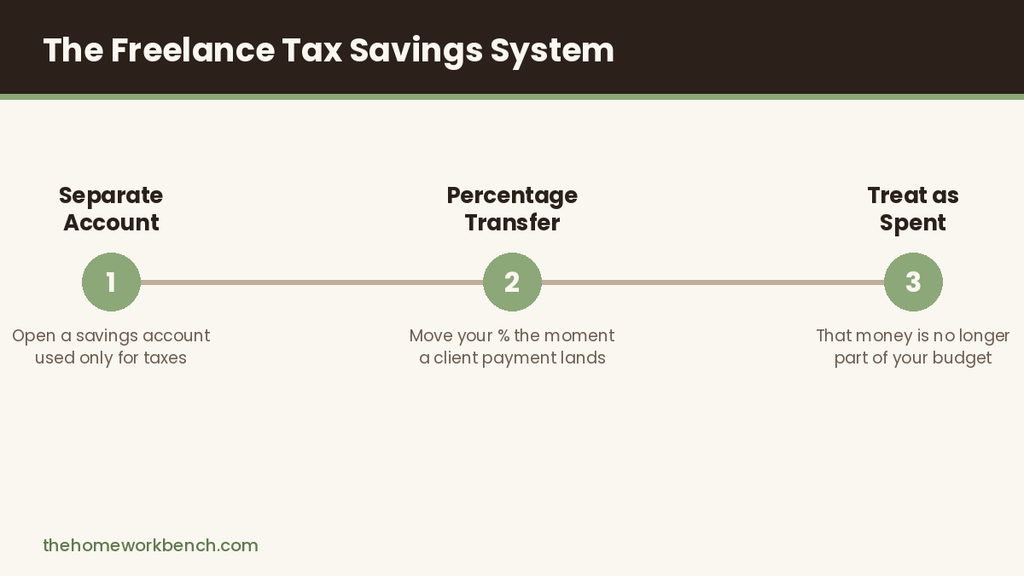
Three-step freelance tax savings system: open a separate account, transfer a percentage the moment payment arrives, and treat that money as already spent
- Open a separate savings account used for nothing except tax money.
- The moment a client payment arrives, transfer a fixed percentage of it into that account — before you touch the rest.
- Treat that transferred money as already spent. It isn’t yours to budget with.
The exact percentage depends on your local tax rules, your income level, and whether you owe income tax alone or also self-employment-type contributions. Because that mix varies so much by country, the next section walks through how to figure out your own number rather than handing you one that may not apply to you.
How to Estimate Your Own Percentage
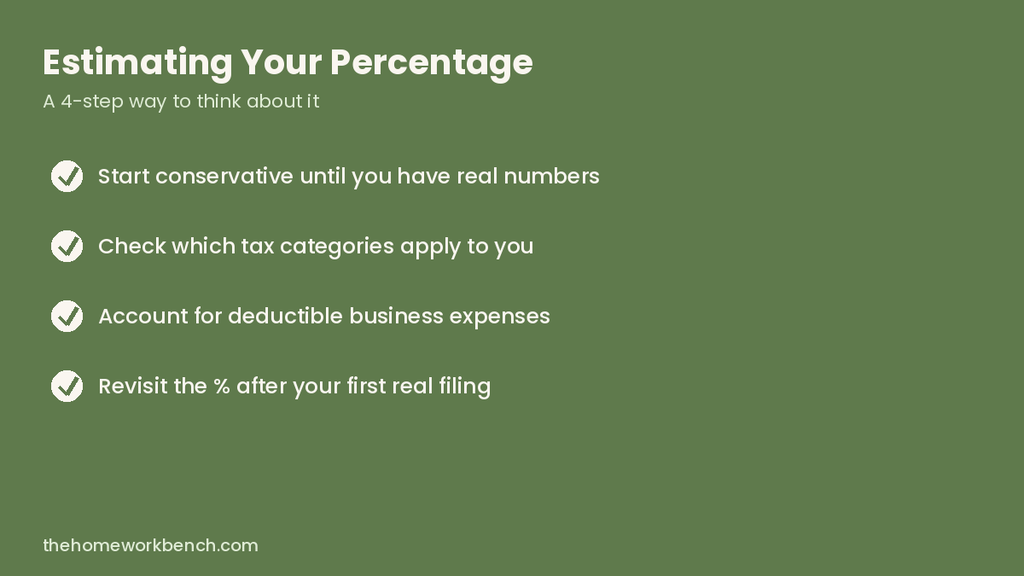
Four-step checklist for estimating your tax savings percentage: start conservative, check which tax categories apply, account for deductible expenses, and revisit after your first filing
- Start conservative. Many freelancers begin by setting aside somewhere in the range of a quarter to a third of each payment, then adjust once they see their actual tax bill for a full year.
- Check what categories apply to you. Depending on where you’re based, you may owe standard income tax, a self-employment or social-insurance-type contribution, and in some cases a local or regional tax — each with its own rate.
- Account for deductible business expenses. Equipment, software, a portion of home office costs, and similar expenses can lower your taxable income — meaning your effective rate may be lower than the headline number.
- Revisit after your first real filing. Your first year’s actual tax bill, divided by your total income that year, gives you a far more accurate personal percentage than any general estimate.
| Situation | Starting Point to Consider |
|---|---|
| New freelancer, no prior tax bill to reference | Save conservatively until you have a real number to work from |
| Consistent income, one full year of filing history | Use last year’s actual effective tax rate as your baseline |
| Irregular or seasonal income | Save a slightly higher percentage in strong months to cover slower ones |
Treat the table above as a way of thinking about the problem, not a set of tax brackets. Your actual percentage should come from your own filings or a tax professional familiar with your country’s rules.
Automate the Set-Aside
The system fails most often when it depends on remembering to move money manually. Two ways to remove that friction:
- Set up an automatic transfer rule with your bank, if it supports percentage-based or recurring transfers tied to deposits.
- Build the transfer into your invoicing habit — the moment you mark an invoice as paid, move the tax percentage immediately, as a fixed step in your process rather than something you get to later.
Handling Irregular Income
Freelance income rarely arrives in even amounts. Two adjustments make the system hold up when income is unpredictable:
- Save on every payment, not monthly. Percentage-based saving naturally scales with irregular income — a slow month sets aside less, a strong month sets aside more, without you having to recalculate anything.
- Keep a small buffer above your minimum. Rounding your percentage up slightly builds in room for estimation error, rather than leaving you short if your calculations were slightly off.
Common Mistakes
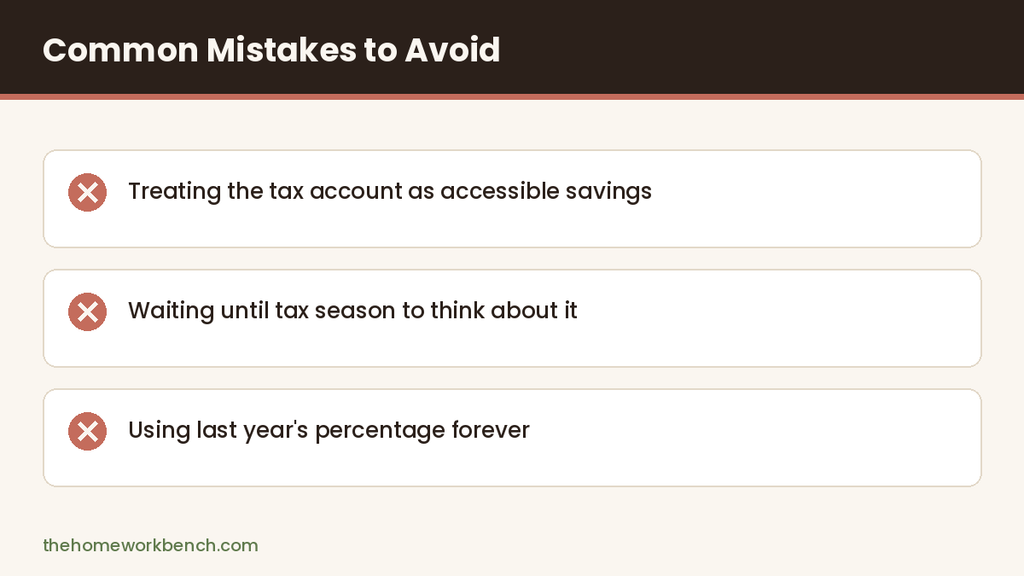
Three common mistakes freelancers make with tax savings: treating the tax account as accessible savings, waiting until tax season to plan, and using last year’s percentage forever
Bottom Line
The freelancers who get caught off guard by taxes aren’t usually the ones who earned unpredictably — they’re the ones who never separated tax money from spending money in the first place. A dedicated account and a consistent percentage, applied automatically at the moment of payment, turns an annual scramble into a non-event.