
If you’ve upgraded your beans, your brewer, and even your water, but your coffee still tastes flat or inconsistent, the grinder is probably the missing piece. Burr and blade grinders don’t just grind coffee differently — they produce fundamentally different particle shapes, and that difference shows up directly in your cup.
The Core Mechanical Difference
A blade grinder works like a small blender: a spinning blade chops beans into whatever size pieces happen to result, mostly determined by how long you run it. A burr grinder works completely differently — beans pass between two abrasive surfaces (the “burrs”) set a fixed distance apart, and every particle that comes out is close to that same size.
This single mechanical difference is the reason burr grinders are considered the meaningful upgrade in a home coffee setup, more so than switching bean brands.
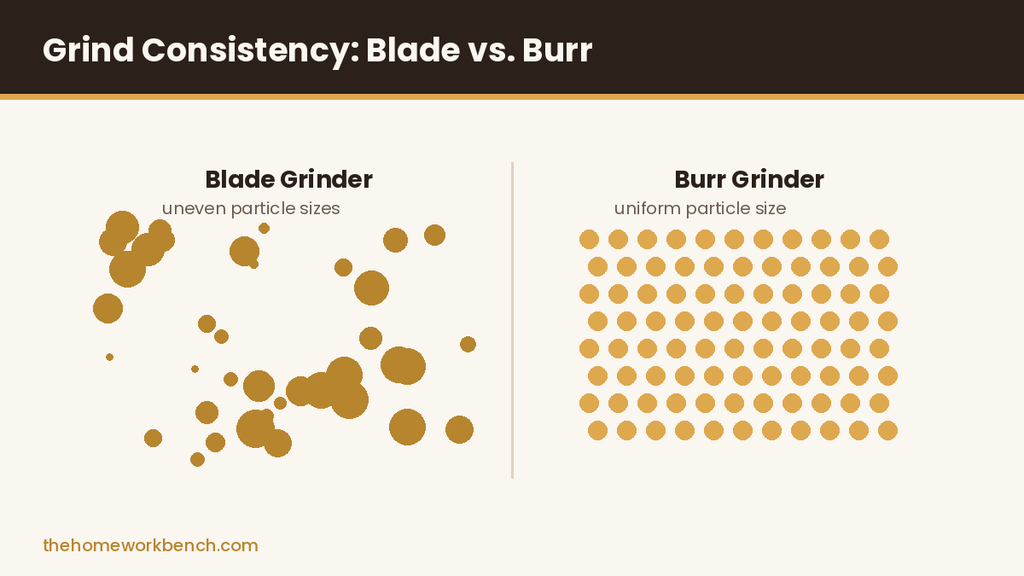
Side-by-side comparison showing a blade grinder’s uneven, randomly sized coffee particles next to a burr grinder’s uniform, evenly sized particles
Why Grind Consistency Changes Flavor
Coffee extraction is a race against time: water pulls flavor compounds out of ground coffee, and different-sized particles finish that race at different speeds. Small particles over-extract (tasting bitter and harsh) while large particles under-extract (tasting sour and weak) — all in the same cup, at the same time, with a blade grinder’s uneven grind.
A burr grinder’s uniform particles all extract at roughly the same rate, which is why burr-ground coffee tastes more balanced, even if you haven’t changed anything else about your brewing method.
Burr vs. Blade at a Glance
| Factor | Blade Grinder | Burr Grinder |
|---|---|---|
| Particle consistency | Uneven — mix of fine dust and large chunks | Uniform — controlled by burr gap setting |
| Grind size control | None — only rough timing control | Precise, adjustable settings |
| Best for | Drip coffee only, in a pinch | Drip, pour-over, French press, espresso |
| Heat generated | Higher (fast blade friction) | Lower, especially with flat/conical burrs at moderate speed |
| Typical price range | Lower cost, entry-level | Wider range — budget hand grinders up through high-end electric models |
Which Brew Methods Actually Need a Burr Grinder
The more precise your brew method, the more a blade grinder’s inconsistency hurts you:
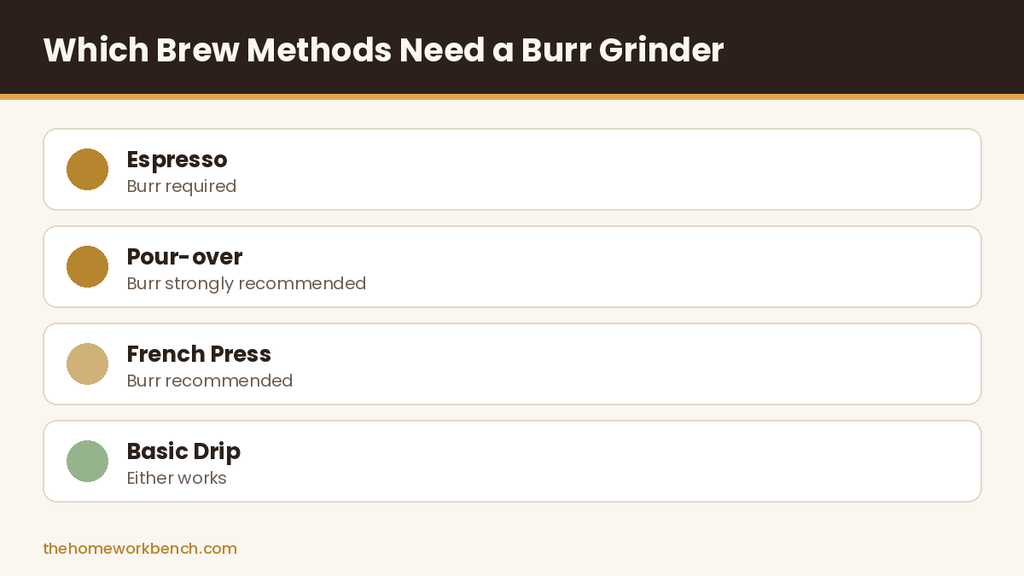
Guide showing which brew methods need a burr grinder: espresso requires it, pour-over strongly recommends it, French press recommends it, and basic drip works with either grinder type
If you only ever brew basic drip coffee and aren’t chasing better flavor, a blade grinder isn’t going to ruin your morning. The gap becomes obvious the moment you try pour-over or espresso.
What You’ll Typically Pay
Blade grinders are generally the cheapest option available, which is why they’re common as a starter or backup grinder. Burr grinders span a much wider range: simple hand-crank burr grinders sit at the entry-level end, mid-range electric burr grinders cover most home setups, and high-end models with precise micro-adjustable settings sit at the top for people dialing in espresso. Exact pricing changes often enough that we’d rather point you to comparison shopping at the time you’re ready to buy than quote numbers that go stale.
Common Myths
- “Expensive beans fix bad grinding.” Grind consistency affects extraction more than bean origin does — a mediocre bean, evenly ground, often outperforms a great bean, unevenly ground.
- “Any burr grinder is a big upgrade.” Low-end burr grinders still have some inconsistency, just less than blade grinders. The upgrade is real, but “burr” alone isn’t a guarantee of great results — burr alignment and build quality matter too.
- “Grind size doesn’t matter for drip coffee.” It matters less than for espresso, but a consistent medium grind still noticeably improves drip coffee’s clarity and balance.
Bottom Line
If you’re serious about improving your coffee and can only upgrade one piece of equipment, make it the grinder before the brewer. A burr grinder gives you consistent, controllable particle size — the foundation every other brewing decision builds on. A blade grinder can get you through basic drip coffee, but it will hold back everything else you try to improve.
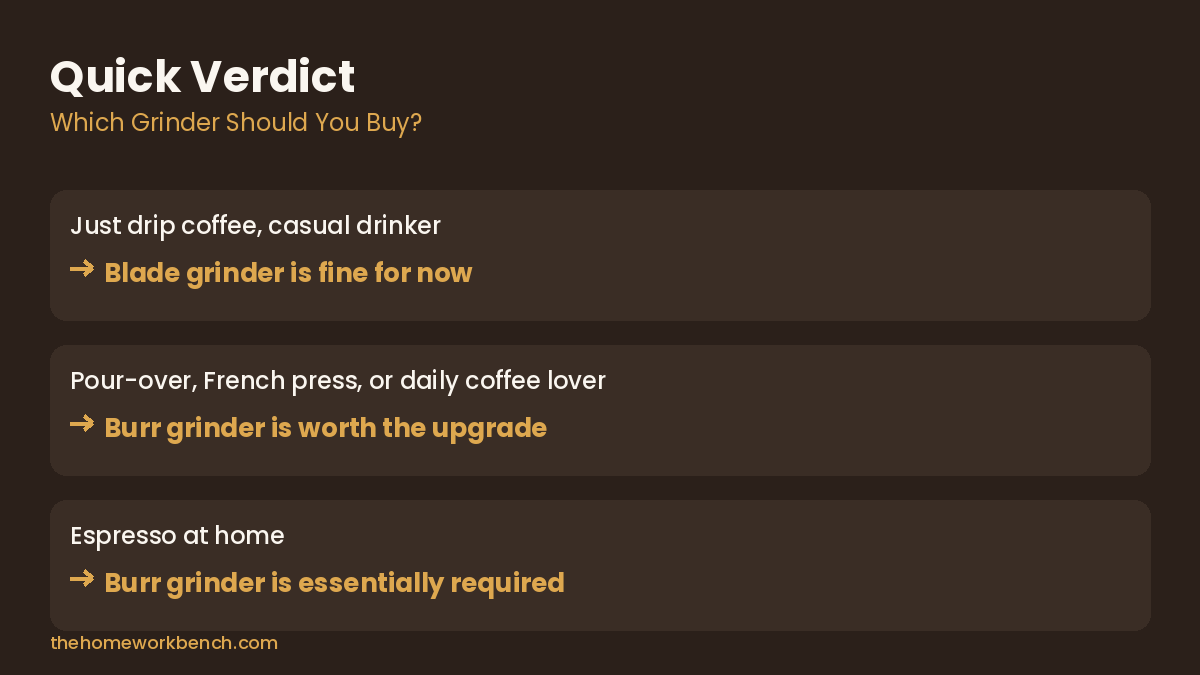
Quick verdict chart matching coffee habits to grinder choice: casual drip drinkers can use a blade grinder, pour-over and French press users should upgrade to burr, and home espresso requires a burr grinder