

Korean cosmetics set a first half record in 2026. Small and medium sized companies exported 5.07 billion dollars of cosmetics between January and June, up 30.7 percent, with exports to Latin America up 131.9 percent and to Europe up 62.4 percent. Separate figures show the United States as the biggest market. This guide puts the reported numbers in one place and says which source each one comes from.
The small business numbers
The Herald Business reported on July 23, 2026 that exports by small and medium sized companies reached a record 64 billion dollars in the first half, up 11.6 percent, according to the Ministry of SMEs and Startups. It was the first time such exports passed 60 billion dollars in a first half, and the previous record was 59.1 billion dollars in the first half of 2022. The report says the number of exporting small companies rose 2.4 percent to 80,490, the highest first half count on record.

Cosmetics were the largest growth driver. They reached 5.07 billion dollars, up 30.7 percent, which the article describes as a first half record.
| Product | First half 2026 exports | Change |
|---|---|---|
| Cosmetics | $5.07 billion | Up 30.7 percent |
| Semiconductors | $2.28 billion | Up 48.3 percent |
| Semiconductor manufacturing equipment | $2.03 billion | Up 33.2 percent |
| Automobiles | $3.31 billion | Down 15.2 percent |
The article attributes the fall in automobile exports to logistics disruptions linked to the conflict in the Middle East, and it says auto parts rose 1.4 percent.
Where cosmetics are growing fastest
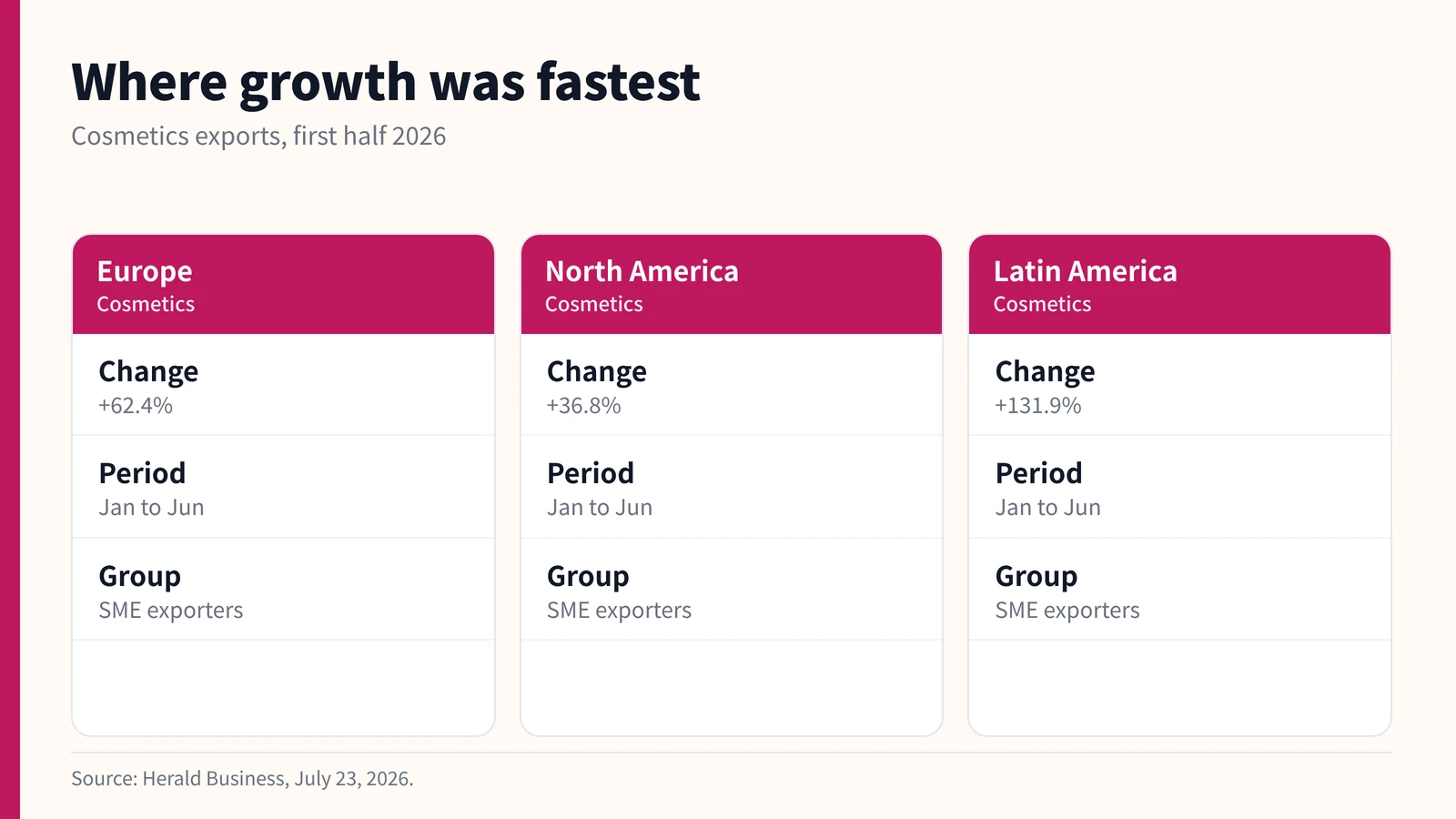
| Region | Cosmetics exports, first half 2026 |
|---|---|
| Europe | Up 62.4 percent |
| North America | Up 36.8 percent |
| Latin America | Up 131.9 percent |
The same report lists the top destinations for all small business exports as China at 10.48 billion dollars, the United States at 9.96 billion, Vietnam at 5.63 billion and Japan at 4.73 billion. Nine of the top ten destinations grew, and Mexico was the only decline. Hong Kong grew 61.8 percent, the fastest among the major markets.
Online exports
Online exports by small companies totaled 740 million dollars, up 48.6 percent, a record. The number of companies exporting online rose 30.5 percent to 4,051. Online cosmetics exports reached 520 million dollars, up 85.3 percent, which is about 70 percent of the 740 million dollar online total.
The whole industry, not only small companies
Personal Care Insights reported on Oct 6, 2026, citing the Ministry of Food and Drug Safety and several Korean outlets, that cosmetics exports reached 7 billion dollars in the first half of 2026. The article gives 3.1 billion dollars for the first quarter and 3.9 billion for the second, and says the 2025 annual record was 11.4 billion dollars. These figures cover the whole sector, so they are larger than the small business numbers above and the two should not be added together.
| Market | Exports | Share or change |
|---|---|---|
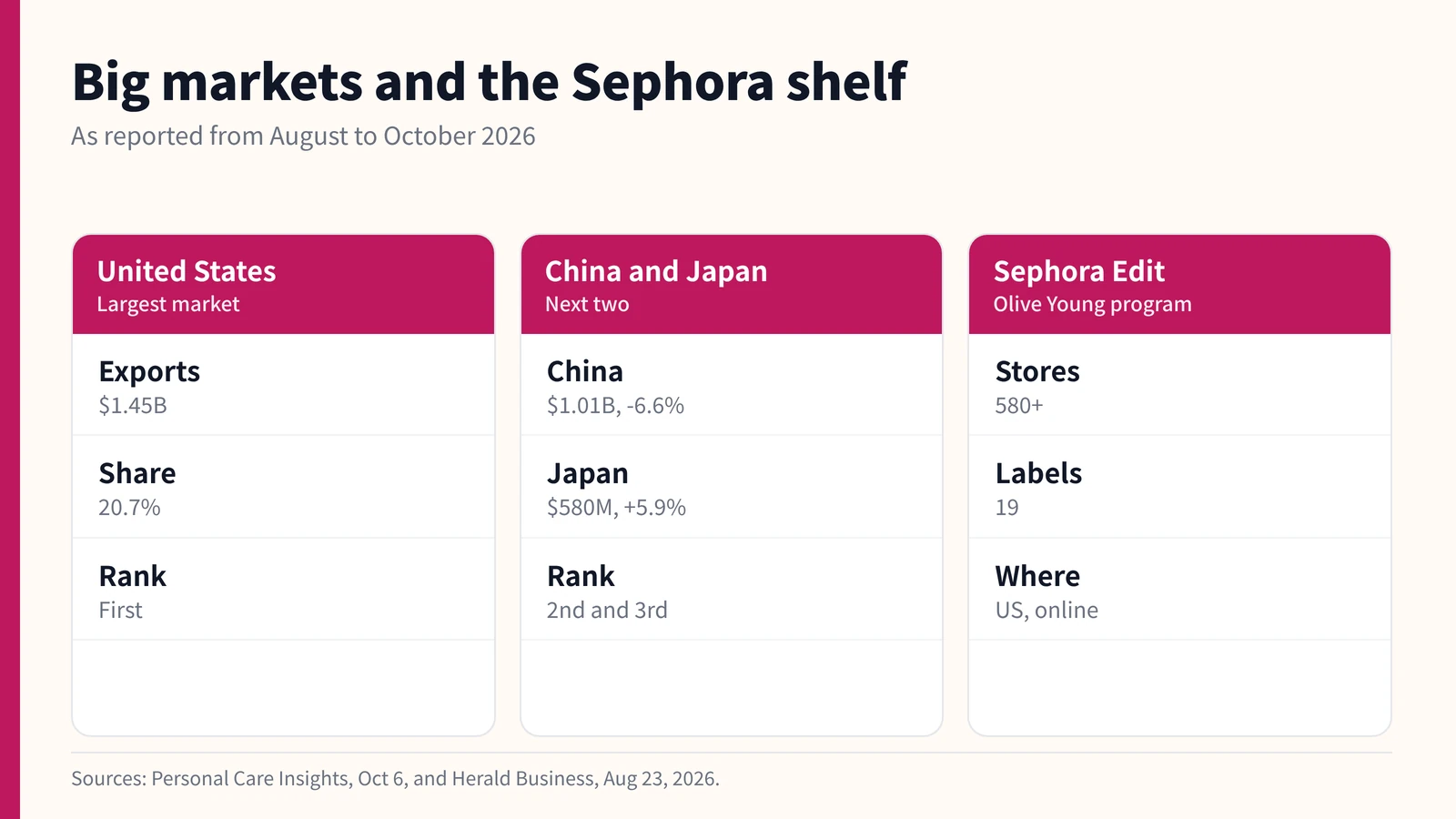
| United States | $1.45 billion | 20.7 percent of exports, the largest market |
| China | $1.01 billion | Down 6.6 percent, 14.4 percent share |
| Japan | $580 million | Up 5.9 percent, third place |
| Skin care, all markets | $5.48 billion | 78 percent of exports |
The July report counts exports by small and medium sized companies and gives a 5.07 billion dollar cosmetics figure for the first half. The October report counts the whole cosmetics sector and gives 7 billion dollars. Both are for January to June 2026, and they describe different groups of exporters.
How Korean brands reach US shoppers
The Herald Business reported on Aug 23, 2026 that CJ Olive Young’s K-Beauty Edit program places Korean brands in more than 580 Sephora stores in the United States and on its online platform, with 19 labels taking part. Hugel sells five products from its Real Hyaluronic line at all US Sephora locations, and the beauty device brand Athhome is the only device maker among the 19 labels. The article also says PharmaResearch acquired the California based cosmetics maker CG USA to support US demand for its Rejuran Cosmetic line.
The same article says observers see Korean beauty exports to the United States shifting from mid and low priced skincare toward high value categories such as pharmaceutical grade dermocosmetics and home aesthetic devices.
Reading the numbers when you shop or research
- Check which group the figure covers: small and medium sized companies, or the whole cosmetics sector.
- Check the period: both sets of figures here are for January to June 2026.
- Use the regional table for growth rates and the market table for size, since a fast growing region such as Latin America is not the same as the biggest market.
- Treat the Sephora K-Beauty Edit as one retail channel among several, with 19 labels in the program.
- Look for the original ministry statistics when you need exact figures for a report.
- Source group checked
- Period checked
- Growth versus size separated
- Original statistics located
Frequently asked questions
How much did small companies export in cosmetics in the first half of 2026?
5.07 billion dollars, up 30.7 percent, a first half record.
Which region grew fastest?
Latin America at 131.9 percent, ahead of Europe at 62.4 percent and North America at 36.8 percent.
What is the largest market for Korean cosmetics?
The United States, at 1.45 billion dollars or 20.7 percent of exports, according to Personal Care Insights.
How big were online cosmetics exports?
520 million dollars, up 85.3 percent.
What is the K-Beauty Edit?
An Olive Young program that places 19 Korean labels in more than 580 Sephora stores in the United States and online.
Why do the 5.07 and 7 billion dollar figures differ?
One counts small and medium sized exporters and the other counts the whole sector.
Sources
- Herald Business: K-beauty boom drives SME exports to record $64b in first half (July 23, 2026)
- Personal Care Insights: South Korea exports hit record US$7B as US demand surges (Oct 6, 2026)
- Herald Business: K-beauty brands land on Sephora shelves (Aug 23, 2026)
Figures checked against these pages on Oct 29, 2026. Where one page gave two growth rates for the same period, the rate was left out.