

Since March 16, 2026, citizens of 42 countries and regions can use Korea’s Smart Entry Service (SES), the automated immigration e-gates at Korean airports. It works for foreigners aged 17 and older whose fingerprints and face photo were already recorded on an earlier arrival. In practice that means your first trip goes through a staffed counter, and later trips can use the e-gate.
Updated November 8, 2026. Based on the Korea Tourism Organization’s immigration page (last updated Sept 28, 2026), the Ministry of Justice and The Korea Times.
What changed in 2026
Korea first opened its Smart Entry Service to short-term foreign visitors from a small group of partners. The Ministry of Justice’s own summary lists Germany, Taiwan, Hong Kong and Macao in 2025, followed by Japan, Singapore, the UAE, Mexico, the Czech Republic, the United Kingdom, Finland, France, Hungary, Italy, the Netherlands, Portugal, Australia and New Zealand. On March 16, 2026, the ministry announced the list had grown from 18 to 42 countries and regions.
The Korea Tourism Organization’s immigration page confirms the 42-country figure as of March 16, 2026, and was last updated on September 28, 2026. The full list of the 24 nationalities added in March is published by the Ministry of Justice and the Korea Immigration Service, so check your passport country there before you fly.
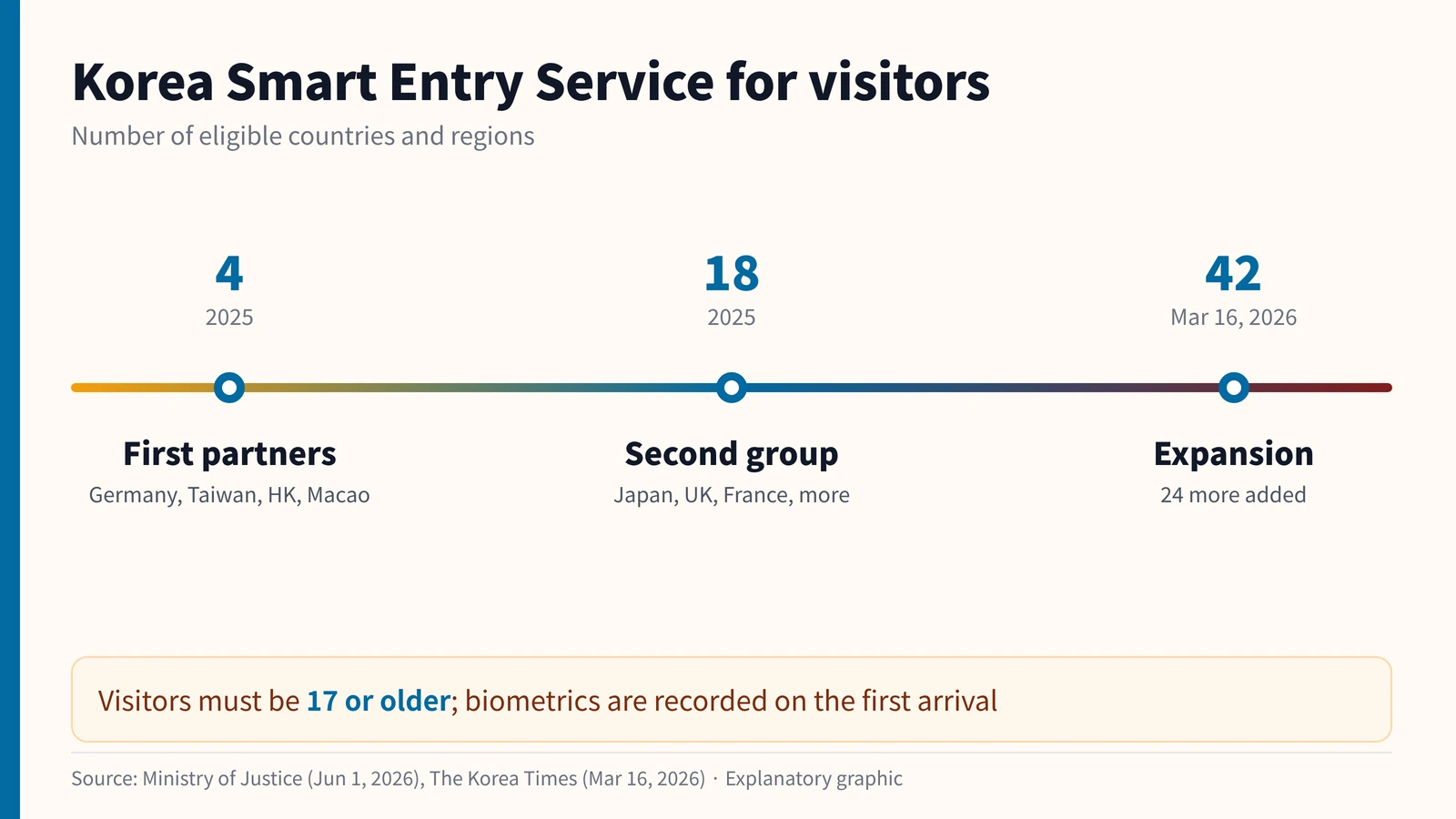
| Stage | Eligible places | Examples |
|---|---|---|
| 2025, first group | 4 | Germany, Taiwan, Hong Kong, Macao |
| 2025, second group | 18 in total | Adds Japan, Singapore, UK, France, Australia and others |
| From Mar 16, 2026 | 42 in total | 24 more countries and regions added |
Who can use the e-gates
Every foreign visitor aged 17 or older goes through mandatory fingerprint and facial recognition at entry, with narrow exceptions for government officials, international organization staff and official guests. That biometric record is what lets you use the gates later. The KTO’s FAQ describes SES as available to foreigners aged 17 or older who have already registered their fingerprints and photo on a previous arrival.
Departure is simpler. Short-term foreign visitors aged 17 and older may use the departure clearance gates without pre-registration, according to the same KTO page.
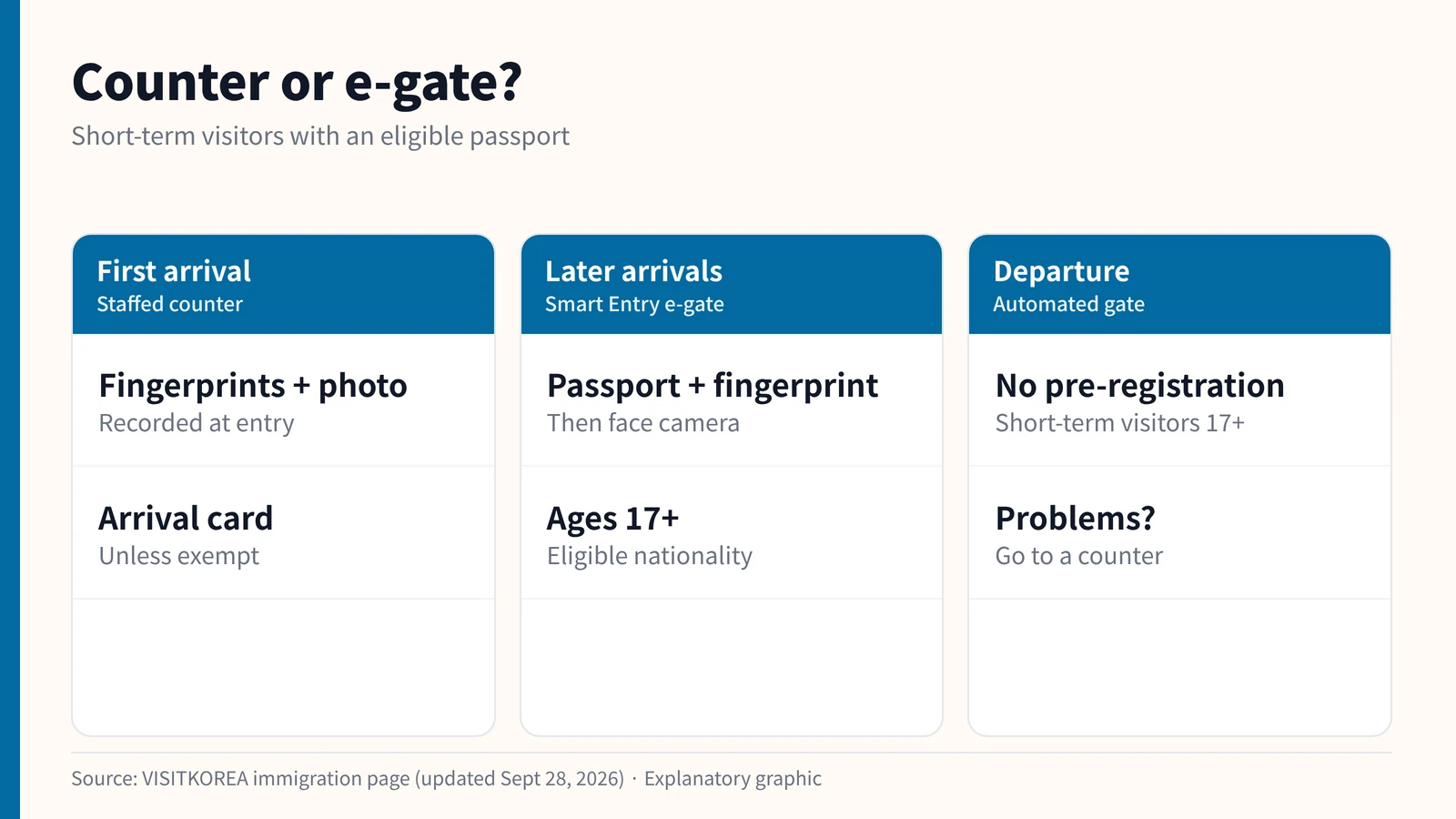
| Situation | What happens |
|---|---|
| First arrival, eligible passport | Staffed counter; fingerprints and face photo recorded |
| Later arrivals, eligible passport | Can use the Smart Entry e-gate |
| Departure, short-term visitor aged 17+ | Departure gate without pre-registration |
| Foreign resident with a Residence Card, aged 17+ | No pre-registration needed |
| Foreign resident aged 14–16 | Pre-registration required |
| Foreign resident aged 7–13 | Advance registration with a legal representative and proof of relationship |
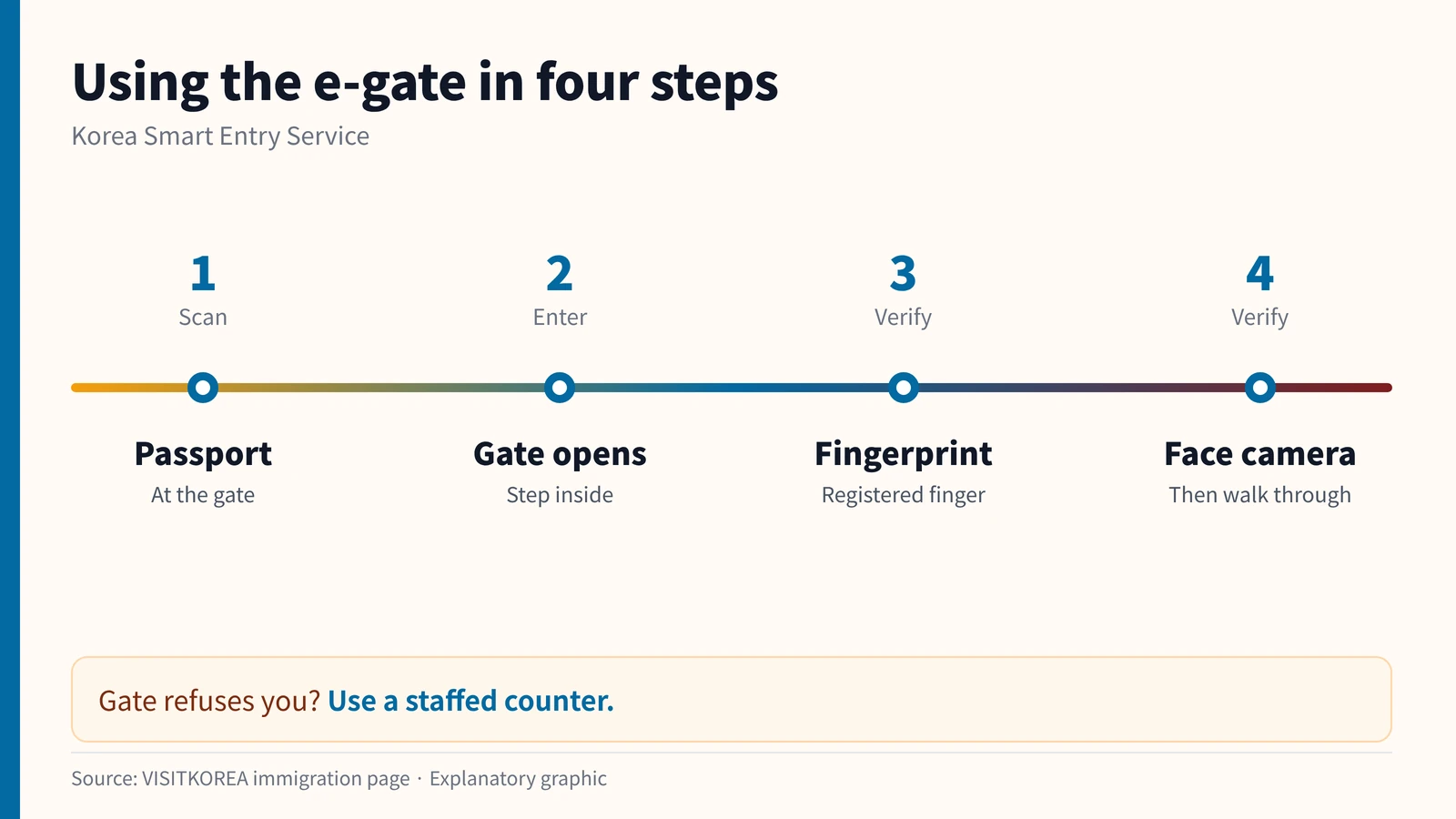
How the e-gate works, step by step
- Scan your passport at the automated gate.
- Step into the gate when it opens.
- Place your registered finger on the scanner.
- Look at the camera for facial recognition, then walk through.
SES is not available to people whose fingerprints cannot be read reliably, people whose entry or exit is restricted under the Immigration Act, or anyone the Minister of Justice deems ineligible. If the gate rejects you, go to a staffed counter.
The other entry paperwork still applies
E-gates speed up passport control but do not replace the rest of the arrival process. Most visitors still need an arrival card, which can be filed online at the e-Arrival card website within three days before arrival (Korea time). K-ETA holders, valid residence card holders and e-Group visa holders are exempt from the arrival card.
| Item | Rule from the KTO page |
|---|---|
| e-Arrival card | Submit online within 3 days of arrival (KST); no printout needed |
| Customs declaration | Only if you have items to declare; app or web form available |
| Duty-free allowance | US$800 total; alcohol up to US$400, 2 bottles, 2 liters; 200 cigarettes; 100 ml perfume |
| Q-Code | Only when arriving from a designated quarantine inspection area |
If you go to a staffed counter
On a first visit, or if the e-gate does not accept your passport, use the foreign passport holders’ line. The KTO page lists two steps: wait for an available immigration officer, then hand over your arrival card (if you need one) and passport. Visitors aged 17 and older give fingerprints and a photo at this point, which is the record later used by the e-gates.
For customs, travelers with goods to declare can fill in the form on the Korea Customs Declaration for Travelers app or the customs website, receive a QR code and scan it at the goods-to-declare gate. Families need only one form, and it must be completed in Korean or English. For help in English or other languages, the 1330 Korea Travel Hotline is reachable at +82-2-1330.
Common mistakes
- Expecting to use the e-gate on your very first trip. Biometrics are recorded at the counter first.
- Assuming every nationality qualifies. Check the official 42-country list.
- Skipping the arrival card because you plan to use the e-gate.
- Bringing a child under 17 to the visitor e-gate. The visitor gates are for ages 17 and up.
FAQ
How many countries can use Korea’s Smart Entry Service?
42 countries and regions, as of March 16, 2026.
Do I need to register before my trip?
Short-term visitors use the e-gate after their biometrics have been recorded on a previous arrival. For departure, short-term visitors 17+ can use the gates without pre-registration.
Is there an age limit?
Short-term visitors must be 17 or older.
Do I still need an arrival card?
Most visitors do, unless they hold a K-ETA, a valid residence card or an e-Group visa.
Where can I see the full list?
On the Ministry of Justice and Korea Immigration Service websites.