

Korean authorities say counterfeit K-beauty is growing alongside the products’ popularity. Korea’s intellectual property office reported seizing more than 140,000 counterfeit items worth 432.6 billion won in 2025, the food and drug safety ministry says inspection cases of suspected counterfeit cosmetics bought on overseas platforms rise from 1,080 in 2025 to 1,200 in 2026, and on Oct 2 a new government council met for the first time. This guide collects what has been reported and what shoppers can do with it.
The reports so far
| Date | Report | What it said |
|---|---|---|
| May 12, 2026 | Freyr, citing MFDS | Inspection cases of suspected counterfeit cosmetics bought on overseas direct online platforms rise from 1,080 in 2025 to 1,200 in 2026 |
| Jul 30, 2026 | Korea Times | KIPO opens a pop-up in Seongsu, outside the Olive Young flagship |
| Aug 12, 2026 | Personal Care Insights | Counterfeit K-brand reporting scheduled for full deployment in October |
| Oct 2, 2026 | Korea Times | A council of two ministries meets for the first time |

The 2025 seizures
The Korea Times reported on July 30, 2026 that in 2025 Korea’s intellectual property office seized more than 140,000 counterfeit items worth 432.6 billion won. The same report says the office opened a pop-up called K-Brand Guardian Angels in Seongsu, Seoul, outside the Olive Young flagship store, and described fake cushion compacts and serums and copycat shop signs among the cases. It also attributes a heavy metals concern to authorities and says the office expanded an online portal for reporting counterfeits.
Personal Care Insights reported on Aug 12, 2026 that 97.7 percent of seized counterfeit Korean-brand goods came from China, with cosmetics the largest category. It also reported more than 210,000 counterfeit items removed in 2025, including more than 36,000 beauty items, and about 20,000 fake cosmetics intercepted in the first half of 2026.

Where fakes show up online
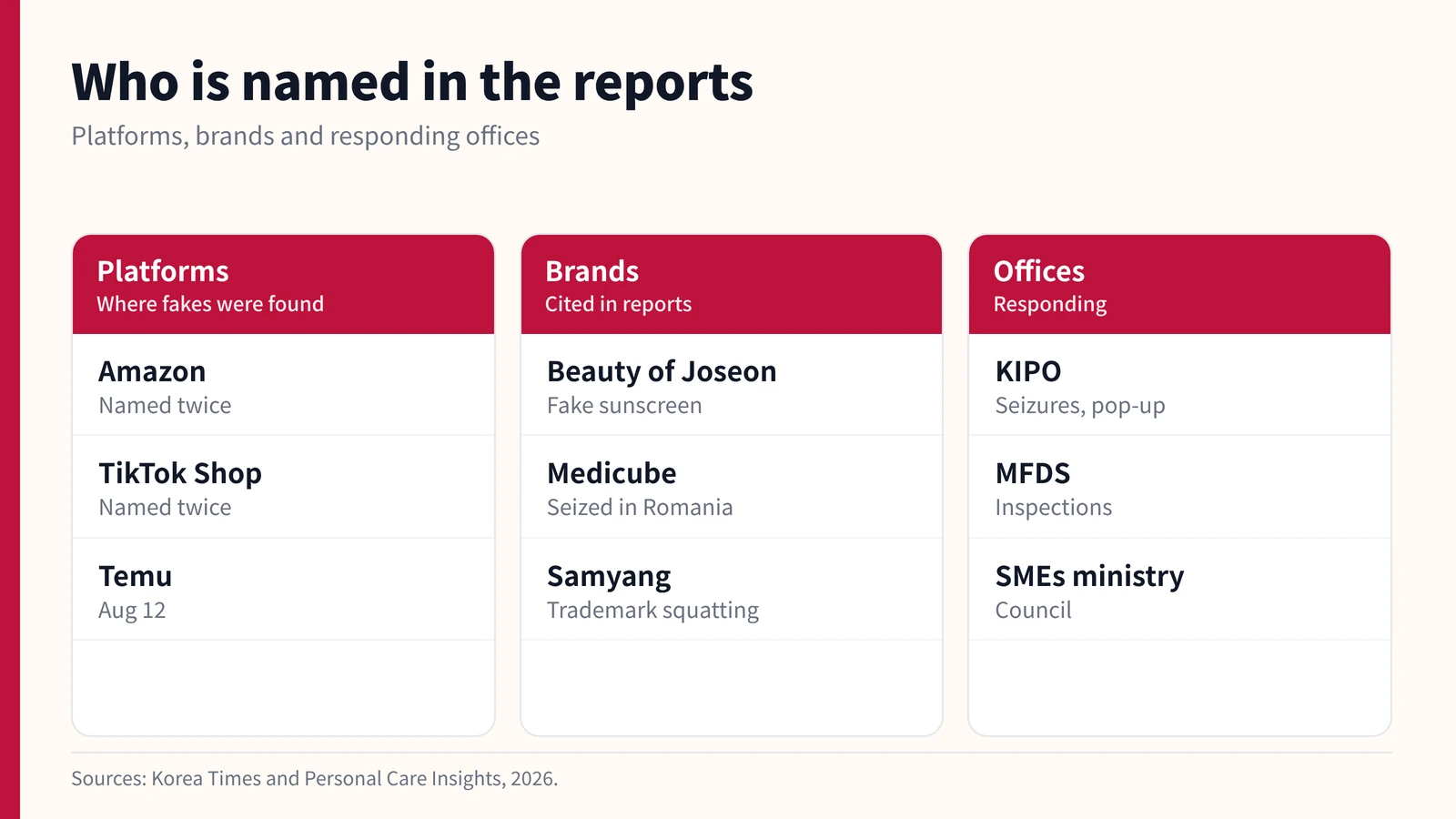
The Korea Times reported on Oct 2, 2026 that a council of the Ministry of SMEs and Startups and the intellectual property office held its inaugural meeting that day, with Amazon and TikTok Shop named among the platforms of concern. It cited a fake Beauty of Joseon Relief Sun: Rice + Probiotics and trademark squatting involving Samyang’s Buldak brand. Personal Care Insights lists Amazon, eBay, TikTok Shop, Temu and Tokopedia as platforms where fakes were found, and says fake Medicube products were seized in Romania and that a Chinese chain called Only Young drew attention.
The intellectual property office article gives no checklist for telling a fake from a real product, so this guide does not offer one. The brand’s own site and official store list are the place to confirm where a product is sold.
What the government is doing
Freyr, citing the food and drug safety ministry’s announcement of May 12, 2026, reports that inspection cases of suspected counterfeit cosmetics bought through overseas direct online platforms rise from 1,080 in 2025 to 1,200 in 2026, as part of work with the intellectual property office and the customs service.
The Korea Times says the Oct 2 council works through 22 Global Business Centers in 14 countries and 10 overseas IP centers in 40 countries. Personal Care Insights reports that the counterfeit K-brand reporting system, which uses a QR code and location, was scheduled for full deployment in October 2026.
What a shopper can do
- Check the brand’s own website for its official stores and authorized online sellers before buying from a marketplace you have not used.
- Be careful with listings on large marketplaces where the reports say fakes were found, and compare the seller with the brand’s official list.
- If you suspect a fake, use the reporting channel for counterfeit K-brand goods described by Personal Care Insights, which uses a QR code and location, once it is available in your country.
- Keep the packaging and your order record if you want to raise a complaint with the platform or the brand.
- Brand’s official store list checked
- Marketplace seller compared with that list
- Order record and packaging kept
- Reporting channel noted
Frequently asked questions
How many counterfeit items were seized in 2025?
The Korea Times reports more than 140,000 items worth 432.6 billion won seized by Korea’s intellectual property office.
Where do most seized fakes come from?
Personal Care Insights reports that 97.7 percent of seized counterfeit Korean-brand goods came from China, with cosmetics the largest category.
Which platforms were named?
Amazon and TikTok Shop in the Korea Times report of Oct 2, and also eBay, Temu and Tokopedia in Personal Care Insights.
What is the new council?
A body of the Ministry of SMEs and Startups and the intellectual property office that held its first meeting on Oct 2, 2026.
Is there a way to report a fake?
Personal Care Insights reports a counterfeit K-brand reporting system using a QR code and location, scheduled for full deployment in October 2026.
Sources
- Korea Times: KIPO pop-up in Seongsu against counterfeit K-beauty (Jul 30, 2026)
- Korea Times: K-brands gain new shield against overseas counterfeits (Oct 2, 2026)
- Freyr: MFDS counterfeit cosmetics inspection plan (May 12, 2026)
- Personal Care Insights: Counterfeit K-beauty (Aug 12, 2026)
Figures checked against these reports on Oct 27, 2026.