
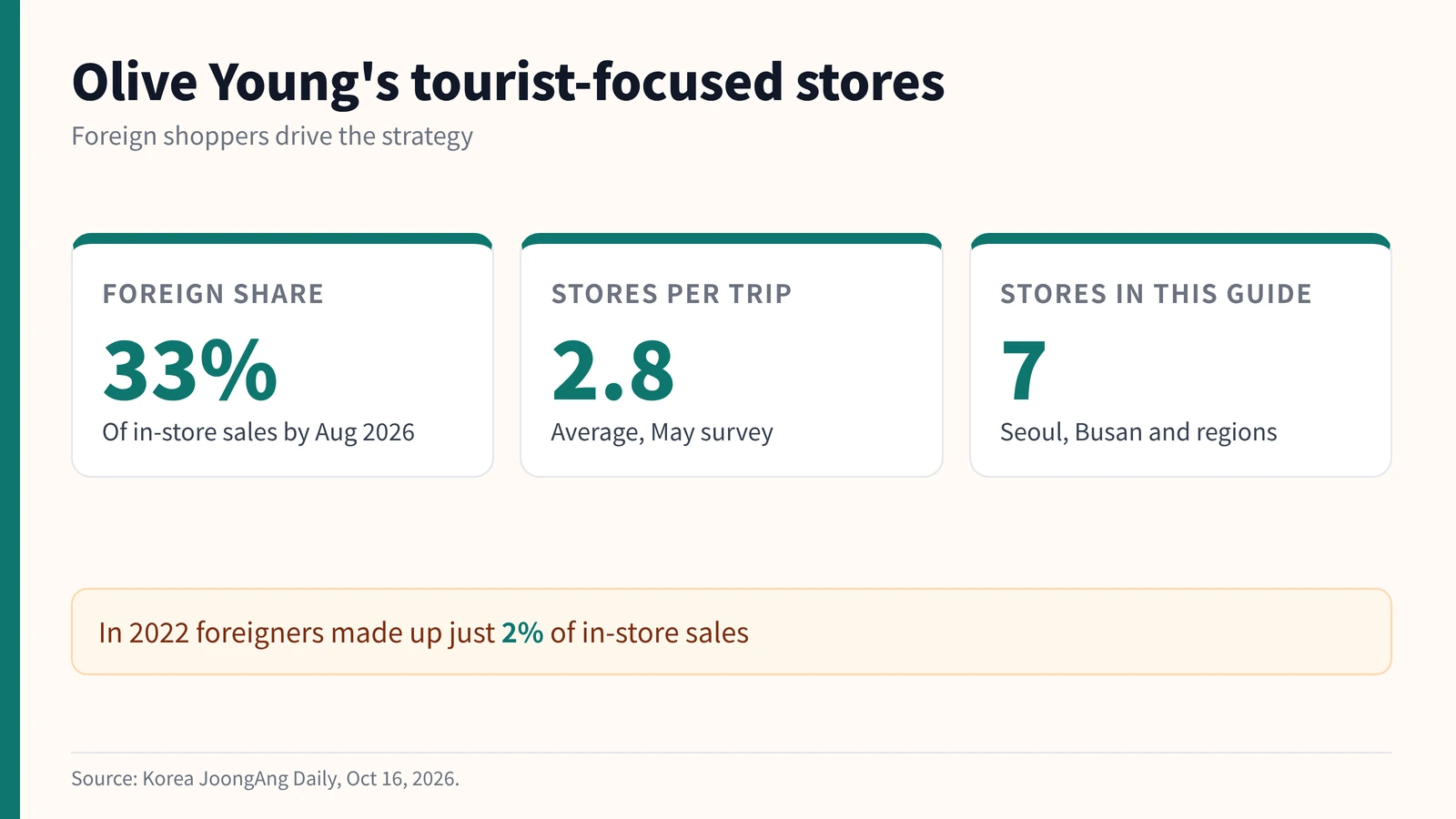
Foreigners made up 33 percent of Olive Young’s in-store sales by August 2026, up from 2 percent in 2022, and the chain is building stores meant to be a stop on a trip rather than just a pharmacy-style shop. The Korea JoongAng Daily’s Oct 16 report describes seven of these design-specialized stores, from a retro market shop in Seoul to a hanok store in Gyeongju and a Jeju store stocked with Jeju-only products.
What a design-specialized store is
CJ Olive Young uses the term design-specialized stores for its tourist-oriented locations, according to the JoongAng Daily, and plans to open more without giving target numbers. In a May survey, foreign shoppers at tourist-area stores visited an average of 2.8 Olive Young stores per trip, which is the reason regional and themed stores matter to the company: shoppers move from store to store.
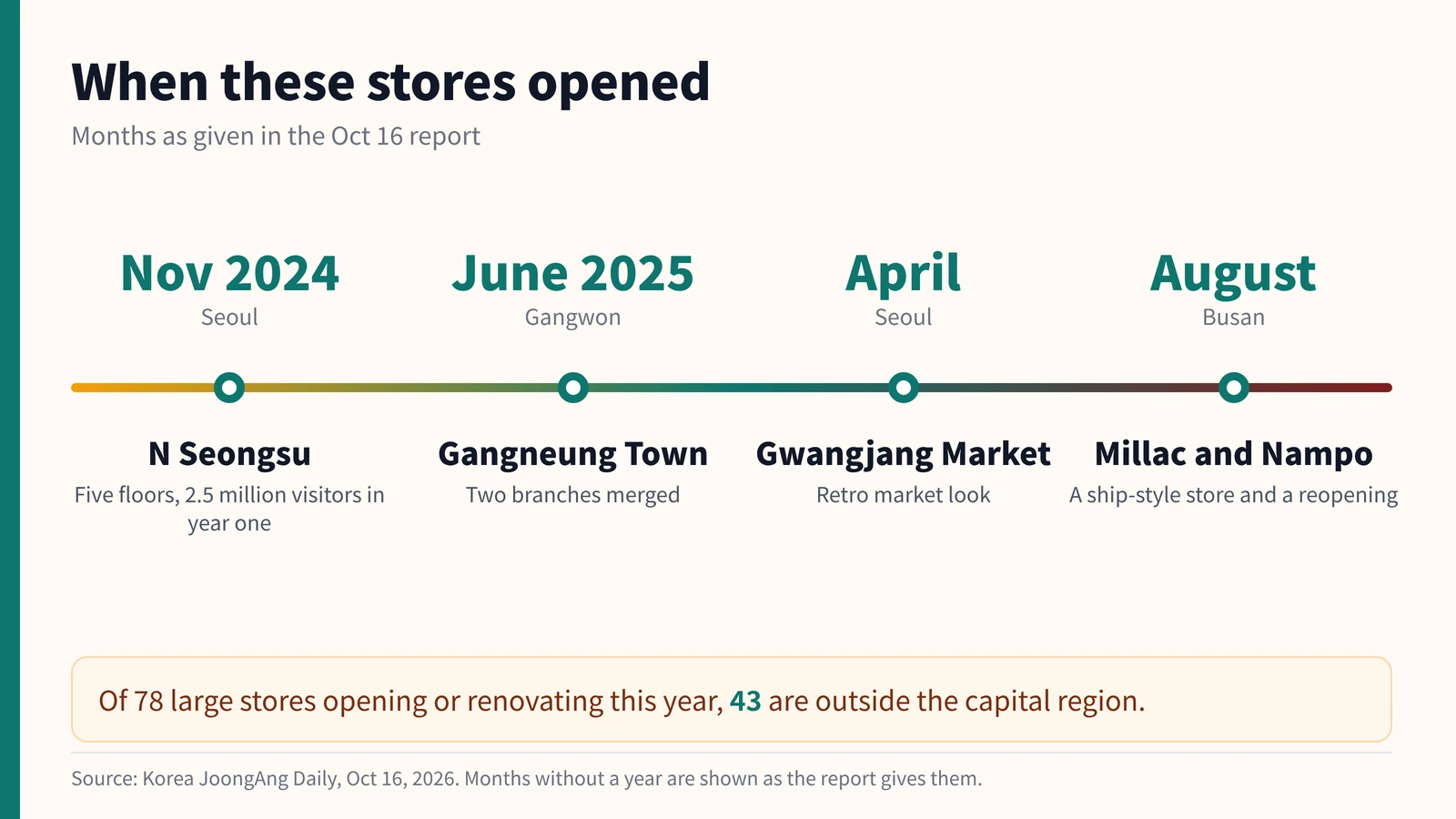
The company’s investment points the same way. In April it announced 123.8 billion won ($92 million) of investment in stores and logistics outside greater Seoul this year. Of 78 large stores to open or be renovated this year, 43 are in regional cities outside Seoul, Gyeonggi and Incheon.
The seven stores at a glance
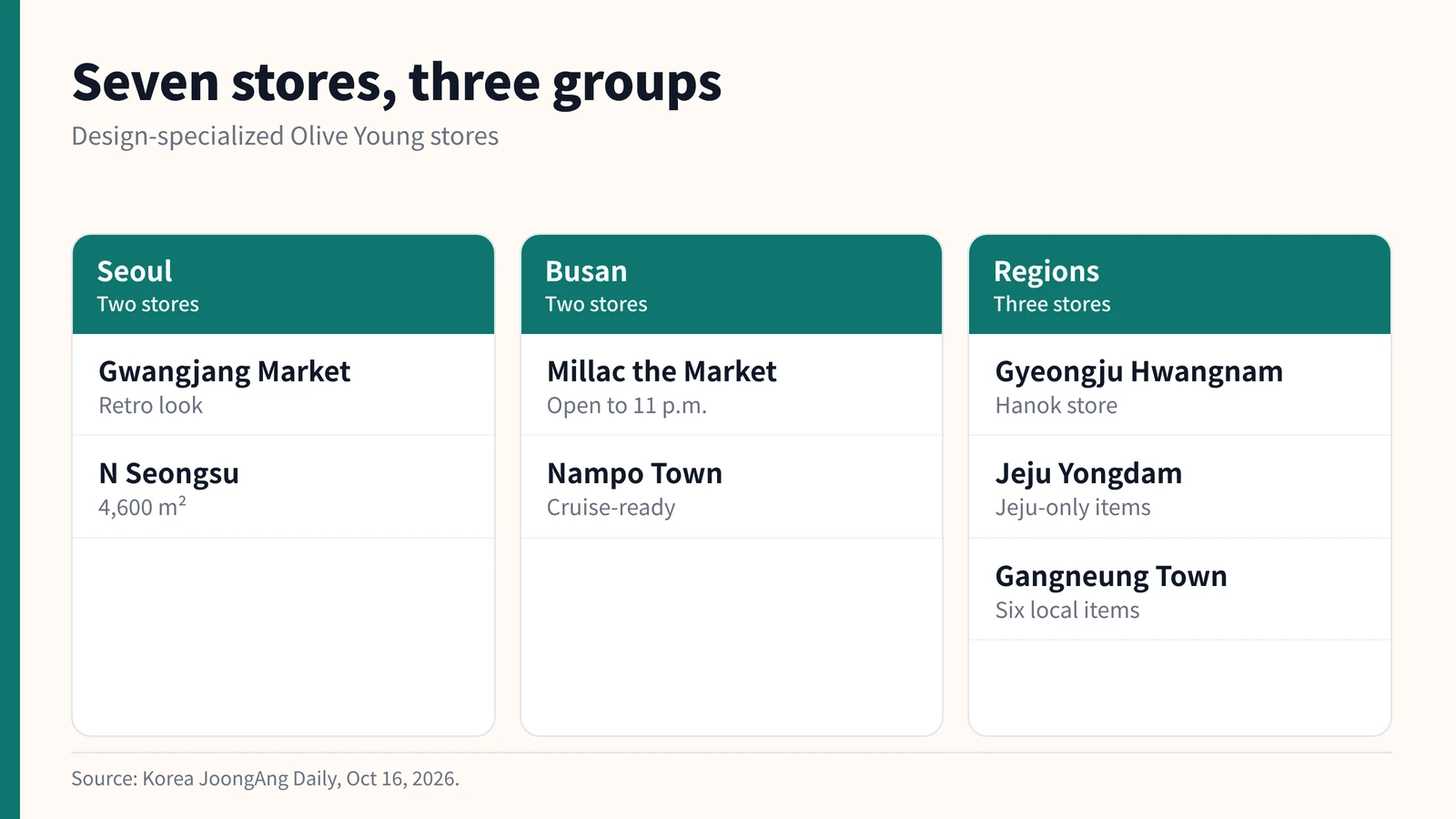
| Store | Where | What sets it apart |
|---|---|---|
| Gwangjang Market | Jongno District, Seoul | Retro market look, personal color matching against hanbok fabric, a hanbok photo zone |
| N Seongsu | Seongdong District, Seoul | Five floors, skin analysis and makeup touch-ups, 2.5 million visitors in its first year |
| Millac the Market | Suyeong District, Busan | Designed as a ship, open until 11 p.m., first Olive Young with an ice cream freezer |
| Nampo Town | Nampo-dong, Busan | Four floors, translation devices, extra staff for cruise passengers |
| Gyeongju Hwangnam | Gyeongju, North Gyeongsang | The chain’s first hanok store, with a courtyard |
| Jeju Yongdam | Jeju City | Jeju-only products made with local tangerines and Udo peanuts |
| Gangneung Town | Gangneung, Gangwon | Six Gangneung-only items, including a body scrub made with the coffee brand Terarosa |
Seoul: Gwangjang Market and N Seongsu
The Gwangjang Market store in Jongno opened in April with retro decor, including a vintage Olyoung Yanghaeng sign and a 1960s-style market shop look. It offers personal color matching against traditional hanbok fabric, a hanbok photo zone and raw ingredients such as green tangerines and mugwort. The report says more than 80 percent of its sales come from foreign customers.
N Seongsu in Seongdong District opened in November 2024 and is the chain’s largest store, with five floors and about 4,600 square meters. It offers skin analysis and makeup touch-ups, and it drew 2.5 million visitors in its first year.
Busan: two very different stores
The Millac the Market store in Suyeong District opened in August near Minrak Port and Gwangalli Beach. It is designed as an imaginary ship called the Olyoung-ho, with fishing nets and views of Gwangan Bridge, it stays open until 11 p.m. and it is the first Olive Young with an ice cream freezer.
The Nampo Town store in Nampo-dong reopened in August after moving from the Gwangbok Town store to a nearby building. It has four floors and about 3,000 square meters, which makes it the chain’s largest store outside greater Seoul. It is laid out for foreign shoppers, with translation devices at the help desk and extra staff for cruise passengers.
Gyeongju, Jeju and Gangneung
In Gyeongju, the Hwangnam store is set in a traditional hanok, the chain’s first hanok store, with its original tiled roof and wooden rafters kept. It has a 165 square meter courtyard with clay figurines modeled on Silla-era tou.
The Jeju Yongdam store in Jeju City features wooden dol hareubang figurines and Jeju-only products made with local tangerines and Udo peanuts. The report gives sales figures for last year’s fourth quarter: tangerine lip balm sales rose 281 percent and a three-pack of hand cream rose 132 percent year over year. About 80 percent of last year’s buyers of the Jeju-only Round A’Round products were foreign tourists.
The Gangneung Town store opened in June 2025 by merging two smaller Gangneung branches into one large-format store near the central market. It sells six Gangneung-only items, including a body scrub made with the coffee brand Terarosa, and it is the first large Town store in Gangwon.
Why shoppers are heading outside Seoul
The report ties the store strategy to tourism figures from the Ministry of Culture, Sports and Tourism. In the first quarter of this year, 34.5 percent of foreign visitors went to regions outside Seoul, up 3.2 percentage points, and arrivals through regional airports rose 49.7 percent.
Building a store route
- Pick a city for the trip, then match it to the store: Seoul for Gwangjang Market or N Seongsu, Busan for Millac the Market or Nampo Town, or a regional stop in Gyeongju, Jeju or Gangneung.
- Plan around the store’s feature. Millac the Market stays open until 11 p.m., and Nampo Town has translation devices and extra staff for cruise passengers.
- Look for local-only items at the regional stores: Jeju-only products at Yongdam and six Gangneung-only items at Gangneung Town.
- Allow time for more than one store, since the May survey found foreign shoppers at tourist-area stores visit 2.8 Olive Young stores per trip on average.
- Cities and stores matched to my itinerary
- Evening plans checked against Millac the Market’s 11 p.m. closing
- Local-only items noted for Jeju and Gangneung
- Time set aside for a second store
Frequently asked questions
What share of Olive Young’s in-store sales come from foreigners?
33 percent by August 2026, compared with 2 percent in 2022, according to the Korea JoongAng Daily.
Which Olive Young store is the biggest?
N Seongsu in Seoul, with five floors and about 4,600 square meters, opened in November 2024.
Is there a store in a hanok?
Yes. The Gyeongju Hwangnam store is the chain’s first hanok store.
Which store stays open late?
The Millac the Market store in Busan is open until 11 p.m.
Where can I buy Jeju-only products?
At the Jeju Yongdam store in Jeju City, which stocks products made with local tangerines and Udo peanuts.
Sources
Figures and store details checked against this report on Oct 27, 2026.