

The Korea Forest Service forecasts peak autumn colour in Seoraksan on October 20, Songnisan on October 28, Naejangsan on November 4 and Hallasan on November 6, 2026. Below is the full schedule, what “peak” means, and a simple way to plan your trip around it.
Updated October 16, 2026 · Based on the Korea Forest Service forecast map (Sept 22) and the Korea Tourism Organization foliage map (Oct 8)
The 2026 peak dates at a glance
On September 22 the Korea Forest Service published its 2026 Korean Peninsula Foliage Peak Forecast Map. It expects the colour to begin in the mountains of northern Gangwon in early October and to reach a nationwide peak in late October, spreading from Seoraksan to the central and southern regions.
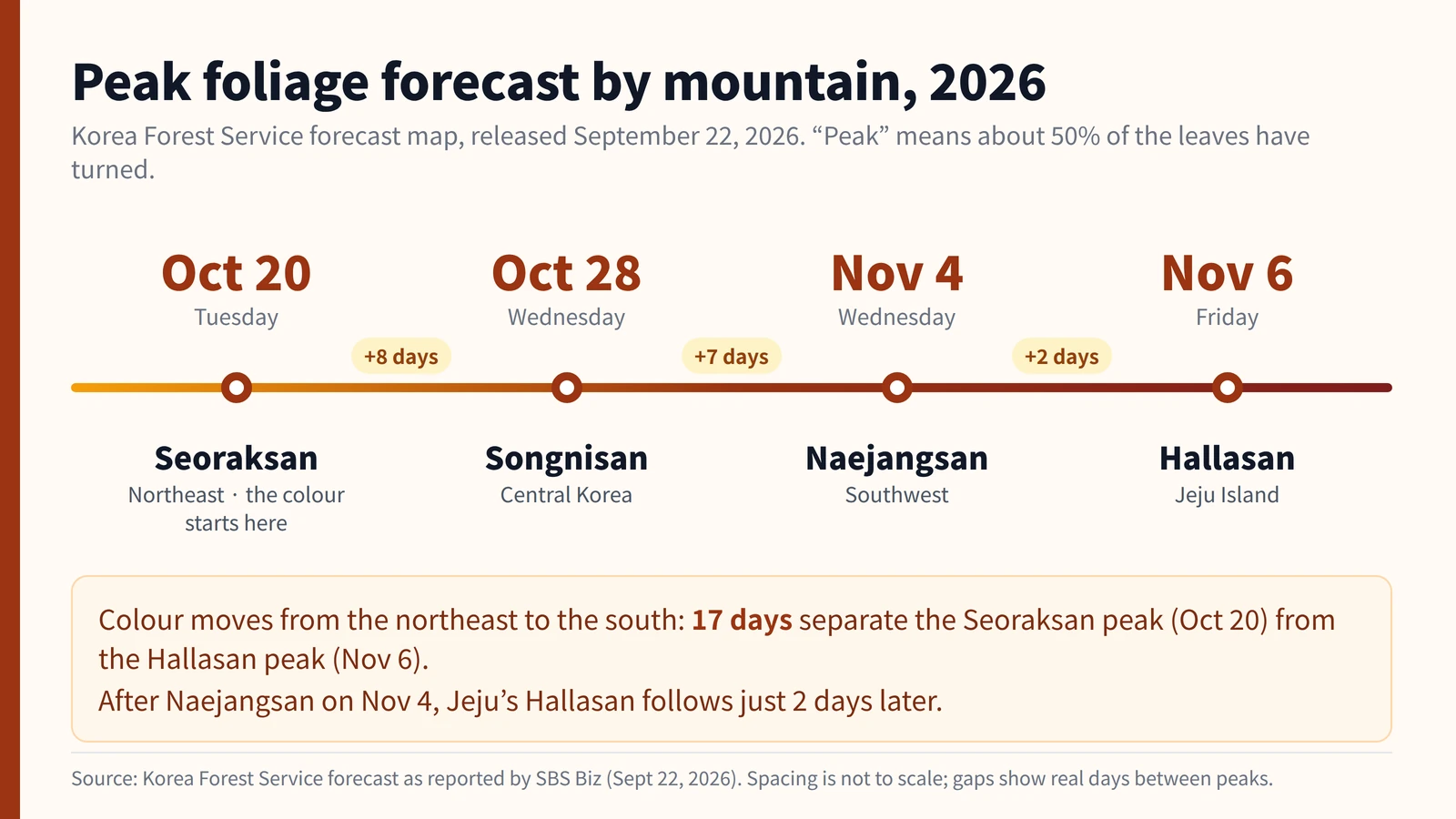
| Mountain | Forecast peak | Weekday | Days from Oct 16 |
|---|---|---|---|
| Seoraksan | October 20 | Tuesday | 4 |
| Songnisan | October 28 | Wednesday | 12 |
| Naejangsan | November 4 | Wednesday | 19 |
| Hallasan | November 6 | Friday | 21 |
From the first peak to the last, the forecast spans 17 days: eight days from Seoraksan to Songnisan, seven more to Naejangsan, and two more to Hallasan on Jeju Island.
What “peak” means and where the forecast comes from
In the Forest Service’s forecast, peak foliage means about 50% of the leaves have changed colour. That is the halfway point, not the last good day to see the colour. Other forecasters can use a different threshold, so compare dates only when the definition is the same.
Treat the date as the centre of a good viewing window rather than a single day. The window is the editor’s advice, not an official range.
The forecast rests on long-term observation. The Korea Forest Service and the Korea National Arboretum have collected plant-seasonal observation data with public arboretums across the country since 2009, and the National Institute of Forest Science collects weather data from mountain areas through its mountain weather network. The Korea Tourism Organization’s foliage map also draws on the Arboretum’s citizen-science Plant Phenology Observation Project; this year it used observations from 829 citizen scientists.
Peak colour by tree type
The forecast also gives dates by tree type, which matters if you are choosing between city streets and mountain trails.
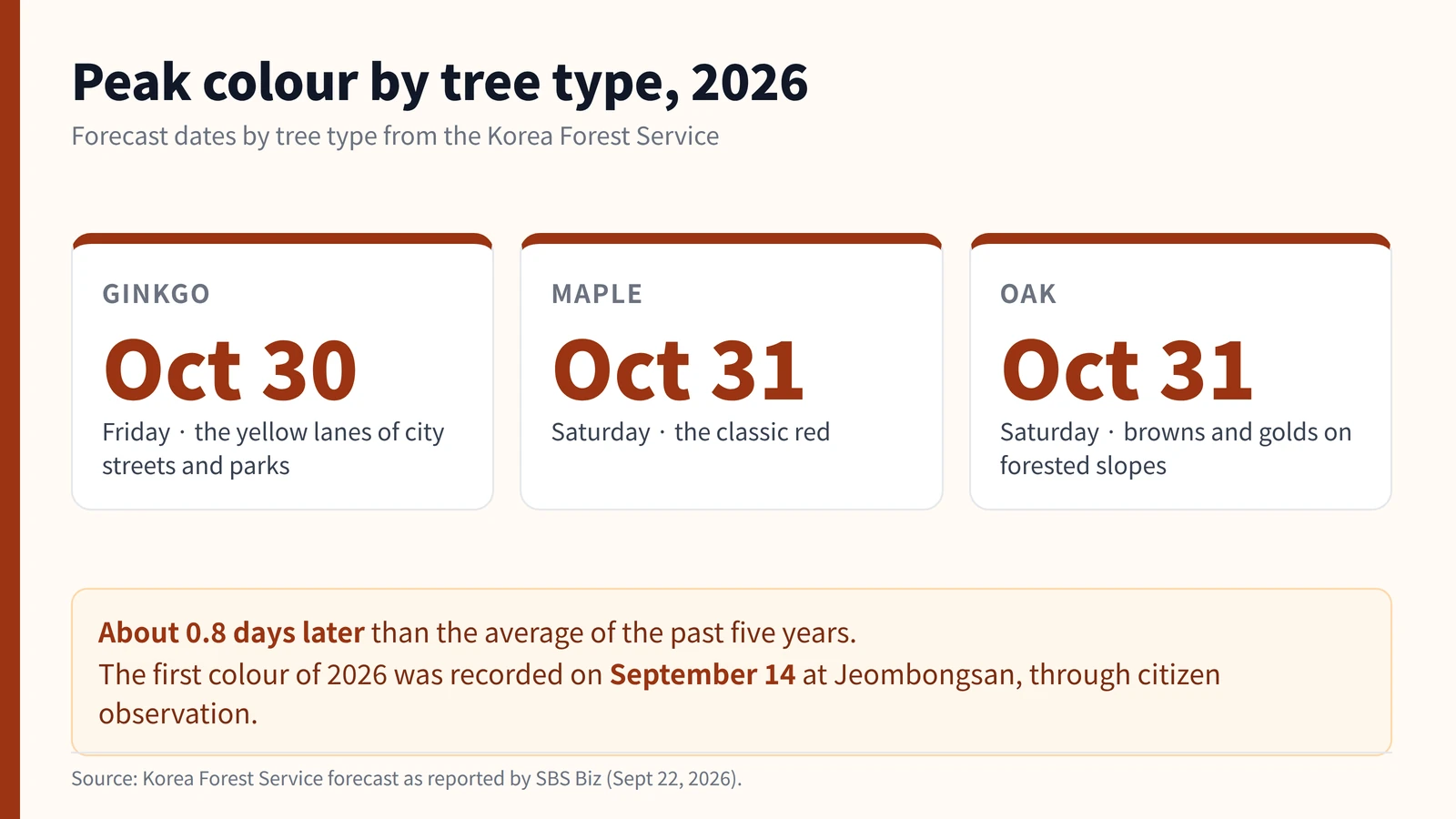
| Tree type | Forecast peak | Weekday |
|---|---|---|
| Ginkgo | October 30 | Friday |
| Maple | October 31 | Saturday |
| Oak | October 31 | Saturday |
The Forest Service says this schedule is about 0.8 days later than the average of the past five years. This year’s first colour was recorded on September 14 at the Jeombongsan forest genetic resources reserve, through a citizen observation.
Region by region: the Korea Tourism Organization map
On October 8 the Korea Tourism Organization released a 2026 Foliage Map together with the Korea National Arboretum. It divides the country into six regions and recommends 36 places. The Seoul metropolitan area and Gangwon are expected to peak from late October, while Gyeongsang and Jeolla follow in early to mid November.
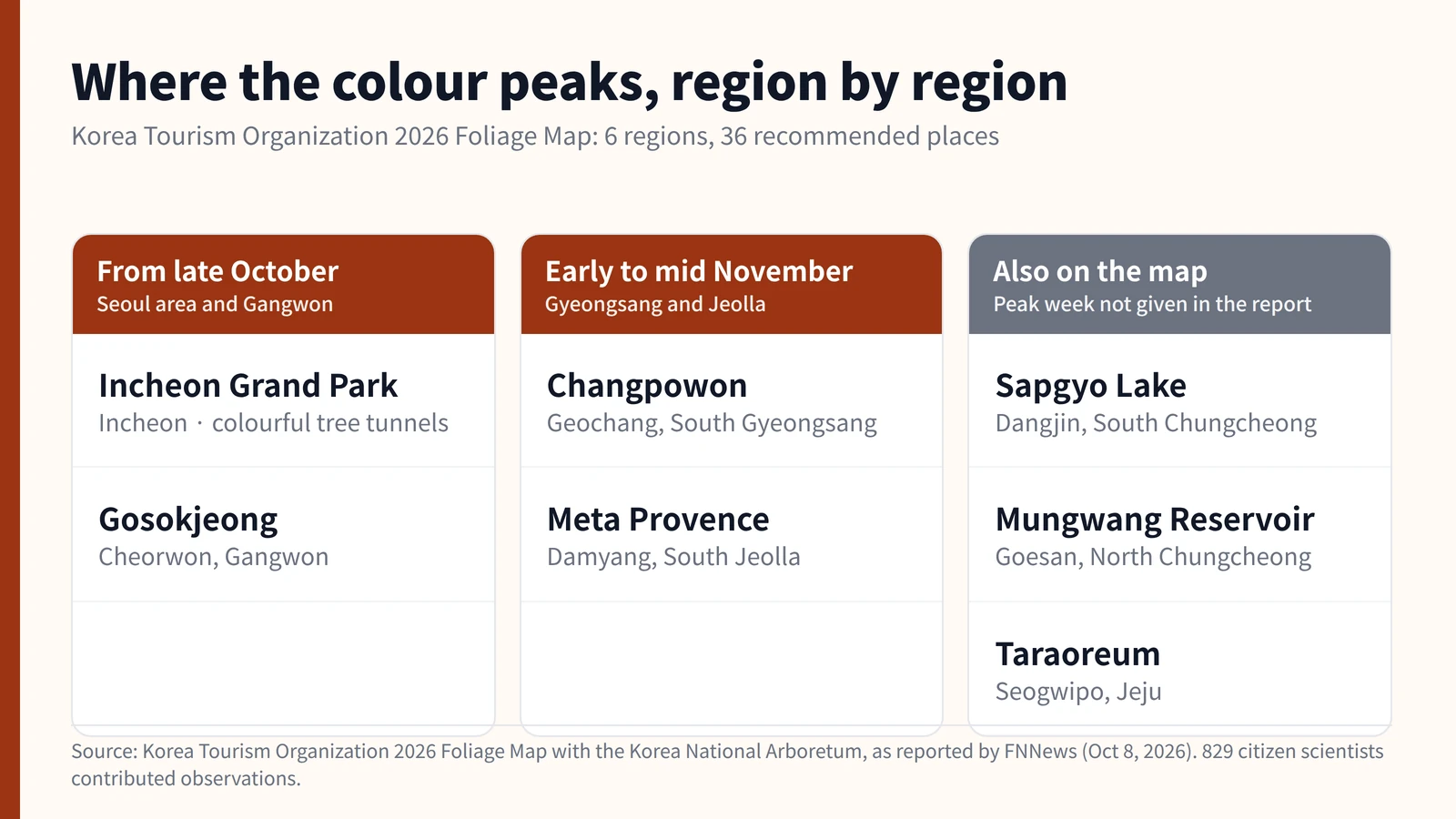
| Timing | Region | Named places |
|---|---|---|
| From late October | Seoul area · Gangwon | Incheon Grand Park (Incheon) · Gosokjeong (Cheorwon, Gangwon) |
| Early to mid November | Gyeongsang · Jeolla | Changpowon (Geochang) · Meta Provence (Damyang) |
| Peak week not stated | Chungcheong · Jeju | Sapgyo Lake (Dangjin) · Mungwang Reservoir (Goesan) · Taraoreum (Seogwipo) |
Incheon Grand Park is described in the report as a place where tree tunnels of many colours line the paths, which makes it the named place closest to Seoul.
A simple plan for your dates
- Fix your travel dates first. Then find the closest mountain peak in the table above.
- Seoul area in late October: the metropolitan area peaks from late October, and the ginkgo and maple dates (October 30 and 31) fall at the end of that window.
- Seoraksan: the earliest major peak is October 20, so a trip in the days around it fits the northeast.
- The south: Gyeongsang and Jeolla peak in early to mid November; Naejangsan is forecast for November 4.
- Jeju: Hallasan is forecast for November 6, two days after Naejangsan.
- Check again before you go. These are forecasts, and colour timing can shift with the weather.
| If you can travel… | Focus on… |
|---|---|
| Around October 20 | Seoraksan and the Gangwon mountains |
| Late October (28–31) | Songnisan, plus ginkgo and maple colour in and around Seoul |
| Early November (4–6) | Naejangsan, then Hallasan on Jeju |
| Early to mid November | Gyeongsang and Jeolla places such as Changpowon and Meta Provence |
Common mistakes
Seoraksan’s date is the first peak, not the nationwide date. The forecast moves south over more than two weeks.
A forecast that waits for more of the leaves to change will give later dates than one that counts half. Check the definition before you compare.
Ginkgo, maple and oak peak a day apart in the forecast, so a city street and a mountain trail on the same weekend can look different.
Frequently asked questions
When is peak foliage in Seoraksan in 2026?
The Korea Forest Service forecasts October 20, a Tuesday.
Is 2026 earlier or later than usual?
About 0.8 days later than the average of the past five years, according to the Forest Service.
When does the colour start?
The first colour of the year was recorded on September 14 at Jeombongsan. Northern Gangwon mountains start in early October, and the nationwide peak comes in late October.
Where can I see autumn colour near Seoul?
The Korea Tourism Organization’s map lists Incheon Grand Park among its 36 places and expects the Seoul area to peak from late October.
What if I travel in mid-November?
Gyeongsang and Jeolla are expected to peak in early to mid November, and Hallasan on Jeju is forecast for November 6.
Where is the full list of 36 places?
On the Korea Tourism Organization’s website 대한민국 구석구석 (Daehanminguk Gusokgusok), where the 2026 Foliage Map is published.
Sources
- SBS Biz — Foliage starts in northern Gangwon in early October, nationwide peak by late October (Sept 22, 2026) — Korea Forest Service forecast map
- FNNews — Korea Tourism Organization releases the ‘2026 Foliage Map’ (Oct 8, 2026) — regions, 36 places, citizen-science data
Checked on October 16, 2026. Forecast dates can change with the weather.